
Wastewater sampling
Our field staff sample wastewater, monitoring wells and soils on your permit's schedule and get the samples to an accredited lab on time.
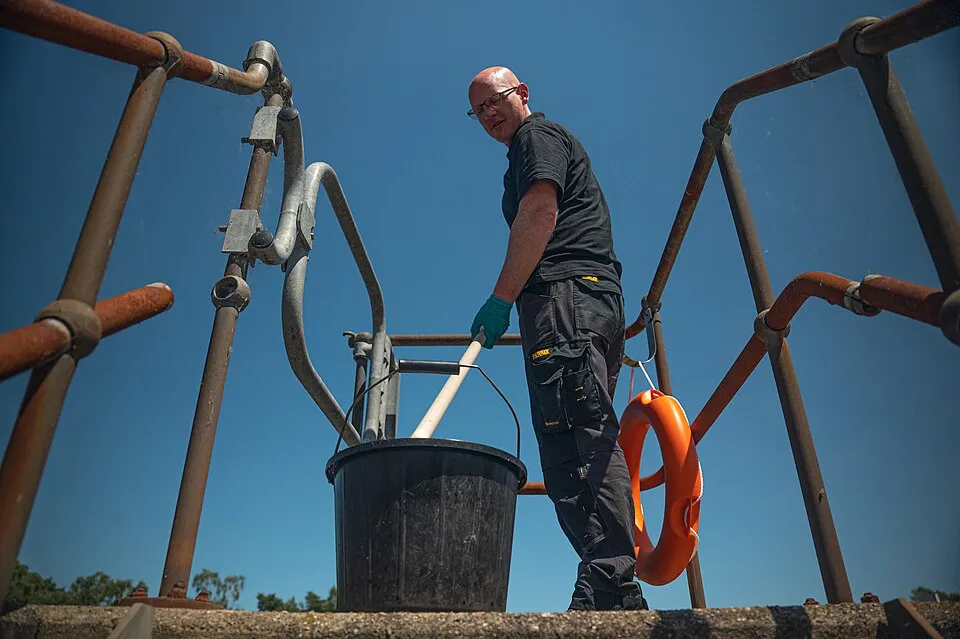
Your permit's monitoring schedule sets the sampling days, sample type and collection period.
Send us your monitoring schedule and the last lab result.
The requirement
Each discharge permit sets what to sample, how often and the sample type: a grab sample at one moment, a time-proportional composite collected at set intervals, or a flow-proportional composite weighted by discharge volume. Samples follow approved methods and hold times and go to an accredited lab.
Who it applies to
Any facility with a wastewater discharge permit.
What we handle
- Grab, time-proportional and flow-proportional composite sampling of process wastewater, as your permit specifies
- Field readings such as pH, temperature and chlorine
- Groundwater monitoring well and soil sampling
- Chain of custody and lab coordination, including special analyses
- Results checked against your permit limits and sent to you
King County examples
For self-monitoring under a King County permit or discharge authorization, see King County Industrial Waste permits.
How a sampling day runs
- We confirm with your site contact when the process will be discharging, so the sample represents normal operation.
- Bottles and preservatives come from the lab ahead of time, matched to your permit's parameter list.
- A composite sample covers the collection period your permit sets, such as 24 hours or the operating day. It is paced the way the permit says: by time, with equal portions at fixed intervals, or by flow, with portions in proportion to the volume discharged. Grab-only parameters such as oil and grease go in their own containers.
- Field readings that aren't on the lab's chain of custody, such as pH, temperature or total chlorine, are recorded on a field sheet with the meter's calibration for that day.
- Samples go to the lab on ice the same day, inside hold times. Some analyses go to a second lab, and we coordinate both.
After the lab
- We check every result against your permit's parameter list and limits, and flag lab qualifiers, hold-time or temperature issues and anything missing.
- An exceedance goes to you the same day, because some permits require a phone call and a written report within days.
- The lab report, field sheet and a short summary go to you and into your shared folder, ready for the DMR or self-monitoring report.
Typical programs
- Monthly compliance sampling for a biotech manufacturer discharging to King County's sewer
- Quarterly composite sampling for a commercial dishwashing equipment and chemical supplier
- Monthly and semiannual sampling for an electronics manufacturer under a State Waste Discharge permit
- Monitoring wells, irrigation water, ditch flow, and crop and soil sampling at a land-application site
- Quarterly sampling under a city minor discharge permit
Common questions
What's the difference between grab, time-proportional and flow-proportional samples?
A grab sample is taken at one moment. A composite covers the collection period your permit sets, often 24 hours or the operating day. A time-proportional composite combines equal portions taken at fixed intervals; a flow-proportional composite takes or weights each portion by the volume discharged. Your permit says the collection period and which type each parameter needs.
Can we take our own samples?
Yes, if your permit allows it and you follow the sampling methods and hold times. We can train your staff or do it for you.
Start with your monitoring schedule
Email us your monitoring schedule and the last lab result, and where the site is. We reply within one business day.